Apr 26, 2025
Overview
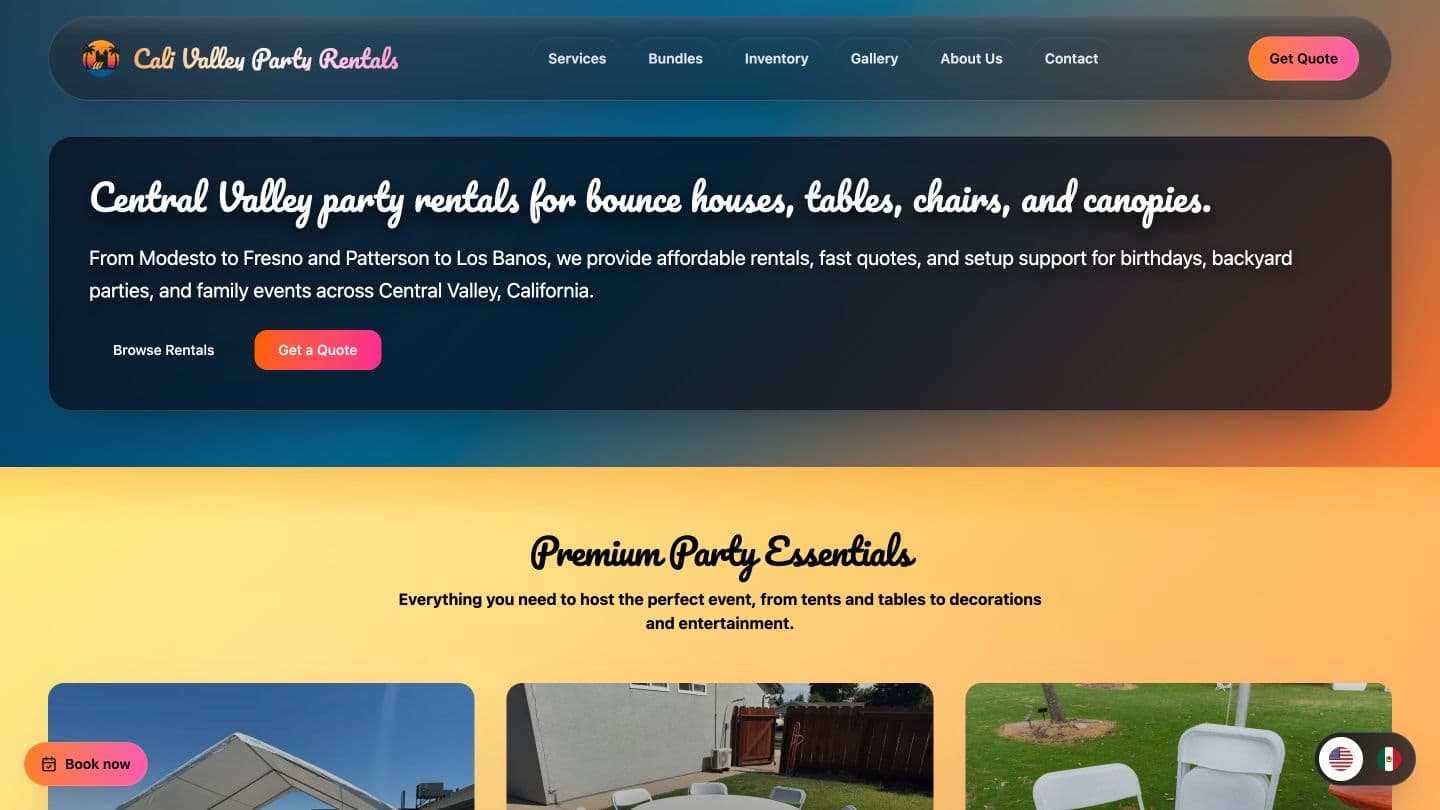
Since April 2025, I have co-owned and operated Cali Valley Party Rentals, a party and event equipment rental business serving California's Central Valley. The business gave me a different kind of engineering brief: acquire local customers, answer their questions clearly, prevent inventory conflicts, coordinate event logistics, collect payment, and keep the owners aligned without stitching the work together across spreadsheets and inboxes.
I built the complete software stack around that operating loop. It includes a bilingual public acquisition and quote experience and a private business operating system for leads, orders, inventory, reservations, estimates, rental agreements, invoices, payment reconciliation, expenses, customer communications, calendars, and dispatch planning.
From Marketing to a Qualified Request
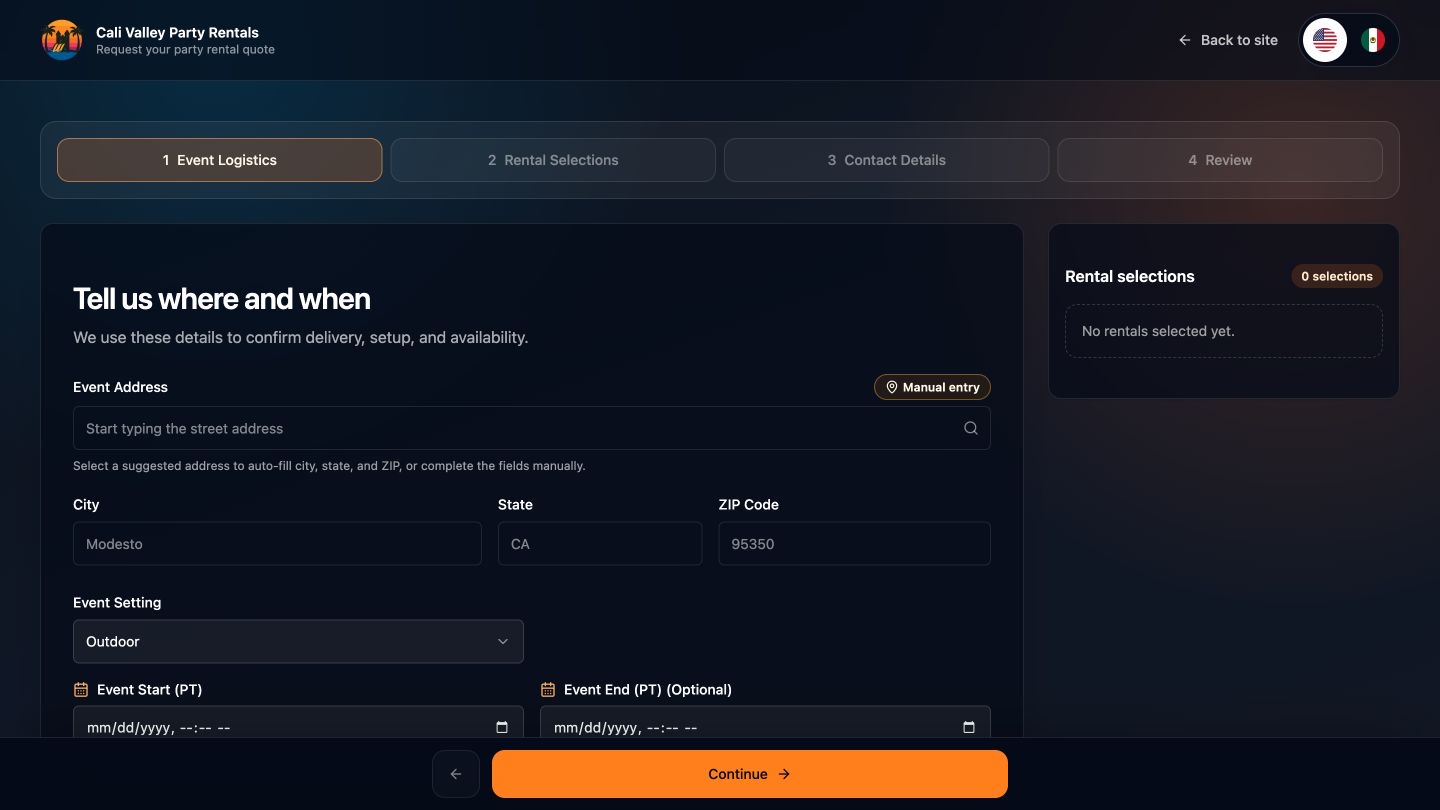
The public product is built for the way a local service business earns trust. Customers can browse services, individual rental items, curated bundles, galleries, policies, and a guided quote flow in English or Spanish. Supabase-backed catalog translations use English as a reliable fallback, while locale-aware routes keep each experience coherent.
I built search-focused metadata, local-business and FAQ structured data, canonical URLs, and a sitemap around that content. I also configured Google Ads and Google Tag Manager support, Vercel Analytics, and privacy-conscious quote-funnel events. The event layer records steps, selections, and outcomes through an explicit allowlist while rejecting customer-entered names, contact details, addresses, dates, and messages.
The CRM and Operating Backbone
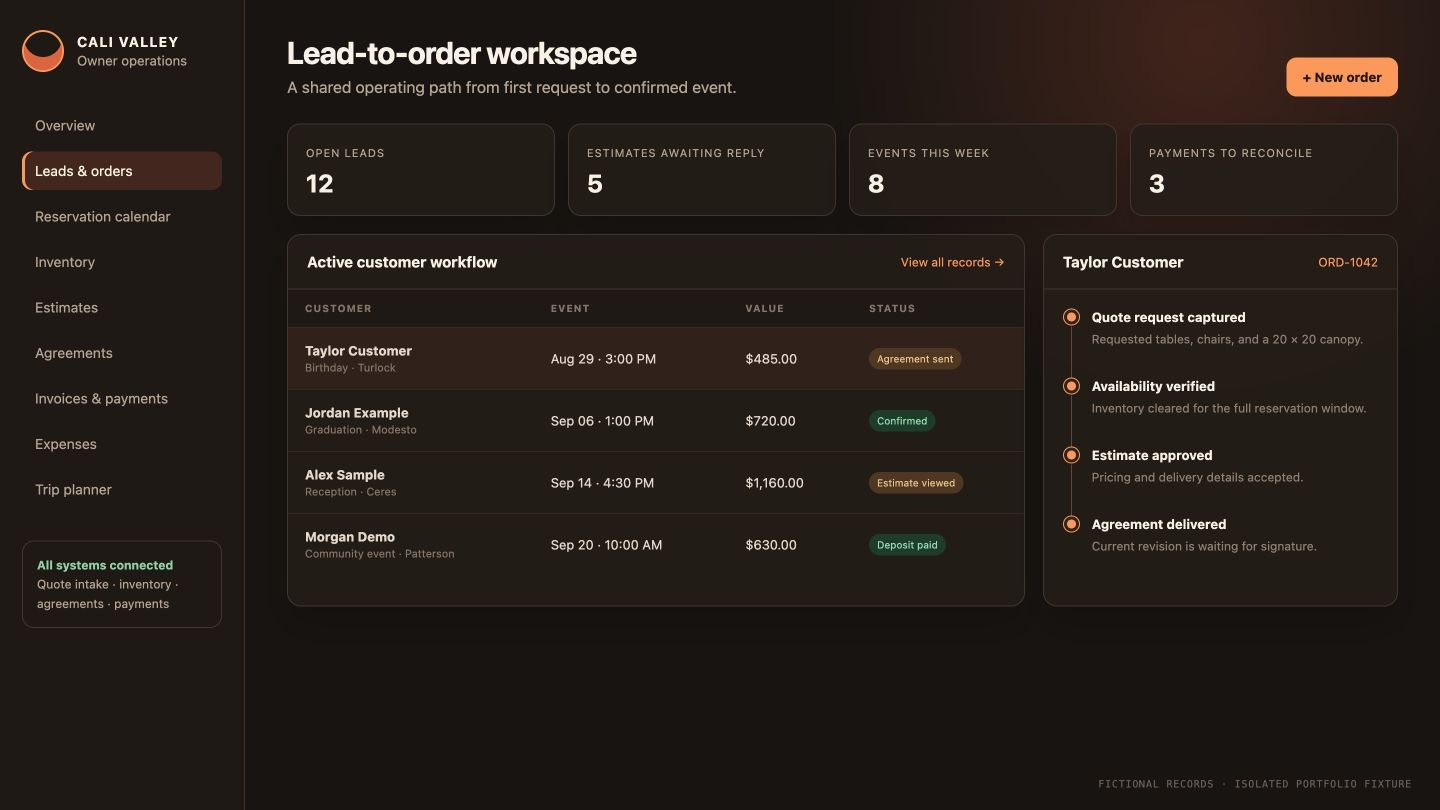
The internal system begins where the public quote flow ends. It gives the owners a shared path from an inbound submission to a lead, estimate, order, agreement, invoice, payment, and completed event. Customer and commercial records stay connected, so an owner can understand the current state without reconstructing it from separate tools.
I built estimate and order workflows with normalized line items, pricing, statuses, customer context, notes, and invoice links. Rental agreements use immutable revisions, expiring signing links, signed PDF storage, and an audit trail for creation, delivery, viewing, and signing. Resend supports customer communication, while PayPal activity can be reconciled against internal invoices and orders through guarded, auditable workflows.
Inventory, Reservations, and Dispatch
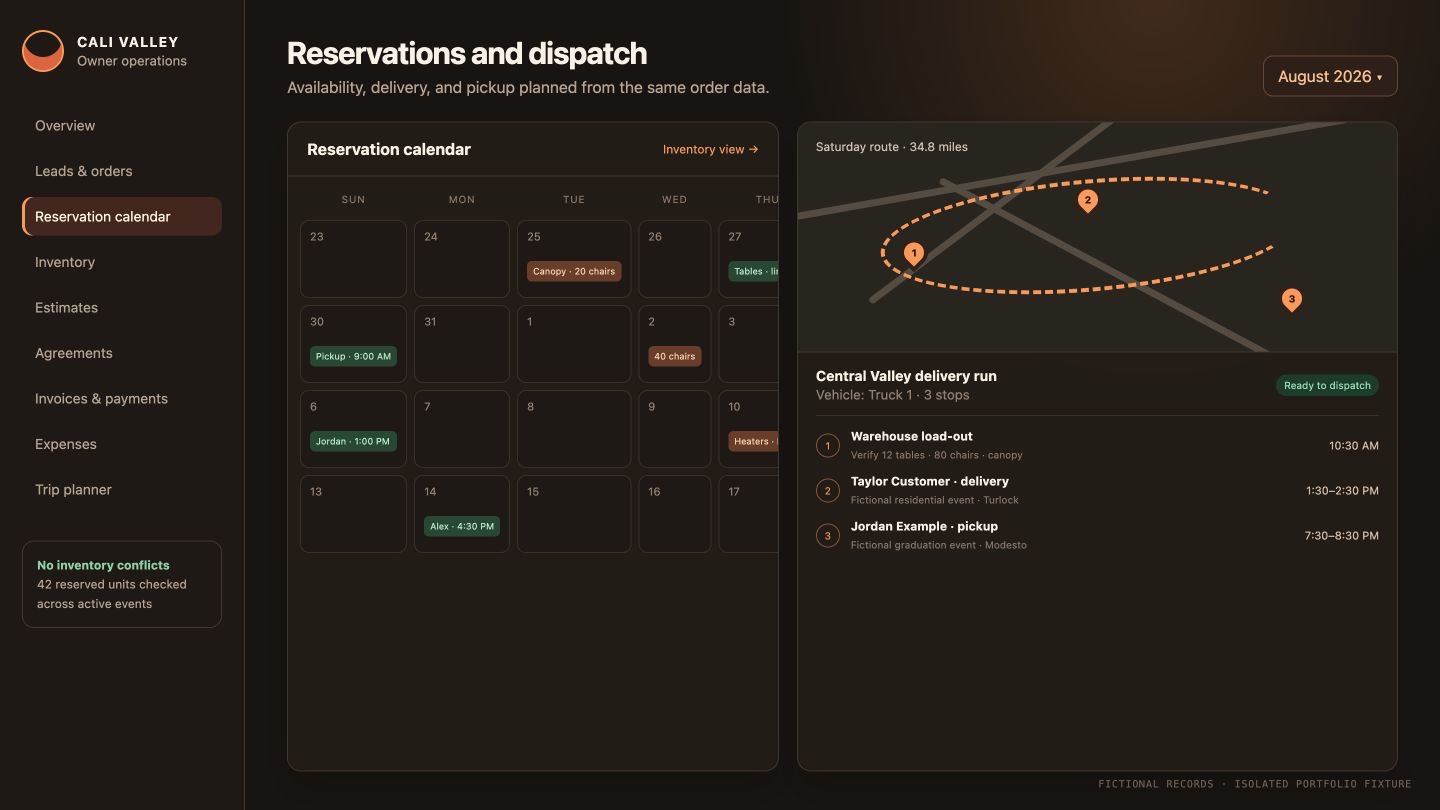
Event rentals are constrained by time and physical stock, not just a product catalog. The system models item categories, rental items, bundles, quantities, pricing rules, reservation windows, and conflicts against active orders. A reservation calendar makes demand visible before another commitment is accepted.
The operations side carries confirmed work into delivery and pickup planning. Orders can be viewed geographically, synced with Google Calendar, and organized into dated trip runs with sequenced stops, time windows, assigned vehicles, and status tracking. Expense records, payment accounts, receipts, and imports add the operating-cost side of the business to the same system.
Architecture
The product is split into two Next.js 16 and React 19 applications managed with Bun: a public customer experience and an authenticated operations application. Supabase provides PostgreSQL, authentication, storage, typed data access, and Row Level Security. Private agreements and receipts remain in protected storage while public catalog and gallery media follow separate access rules.
The surrounding integrations include Resend for transactional communication, PayPal for invoice and payment activity, Google Calendar and Maps for scheduling and location workflows, Google Tag Manager and Google Ads for acquisition measurement, and Vercel for deployment, performance analytics, and speed monitoring. Validation, constrained server actions, audit records, preview/apply operations, and automated tests keep sensitive workflows explicit.
What This Project Demonstrates
CVPR is where my full-stack engineering and business ownership directly meet. I do not only translate a requirements document into software; I help run the operation, encounter its failure modes, decide what deserves automation, build the solution, and use the resulting system during real work.
That feedback loop has developed capabilities across operations management, CRM and sales operations, digital advertising, SEO and conversion analytics, inventory and reservation modeling, payment reconciliation, workflow automation, localization, and dispatch logistics—alongside the architecture, database, frontend, backend, deployment, and reliability work needed to make those capabilities useful.
Highlights
- Co-own and operate the business while leading the design and implementation of its software systems.
- Built a bilingual acquisition, catalog, and guided quote experience with English fallback behavior.
- Connected privacy-conscious quote analytics to Google Tag Manager, Google Ads, and Vercel Analytics.
- Designed the CRM path from inbound interest through estimates, orders, agreements, invoices, payments, and follow-up.
- Modeled inventory, bundles, reservation conflicts, calendars, delivery routes, trip runs, and pickup work.
- Added protected documents, expense tracking, communication automation, external-service reconciliation, and auditable operational actions.
Stack
- Next.js 16, React 19, TypeScript, Bun, Tailwind CSS
- Supabase Auth, PostgreSQL, Storage, Row Level Security
- Resend, PayPal, Google Calendar, Google Maps
- Google Tag Manager, Google Ads, Vercel Analytics, Speed Insights
- Zod, React Hook Form, Recharts, TanStack Table, Playwright, Bun Test