Jan 31, 2025
Overview
ALAS is a specialized OpAssistant product that I built to make manufacturing labor time studies faster, more repeatable, and easier to review. Instead of relying entirely on manual video observation and spreadsheet timestamping, ALAS turns workstation recordings into structured activity data connected to study records and relevant production context.
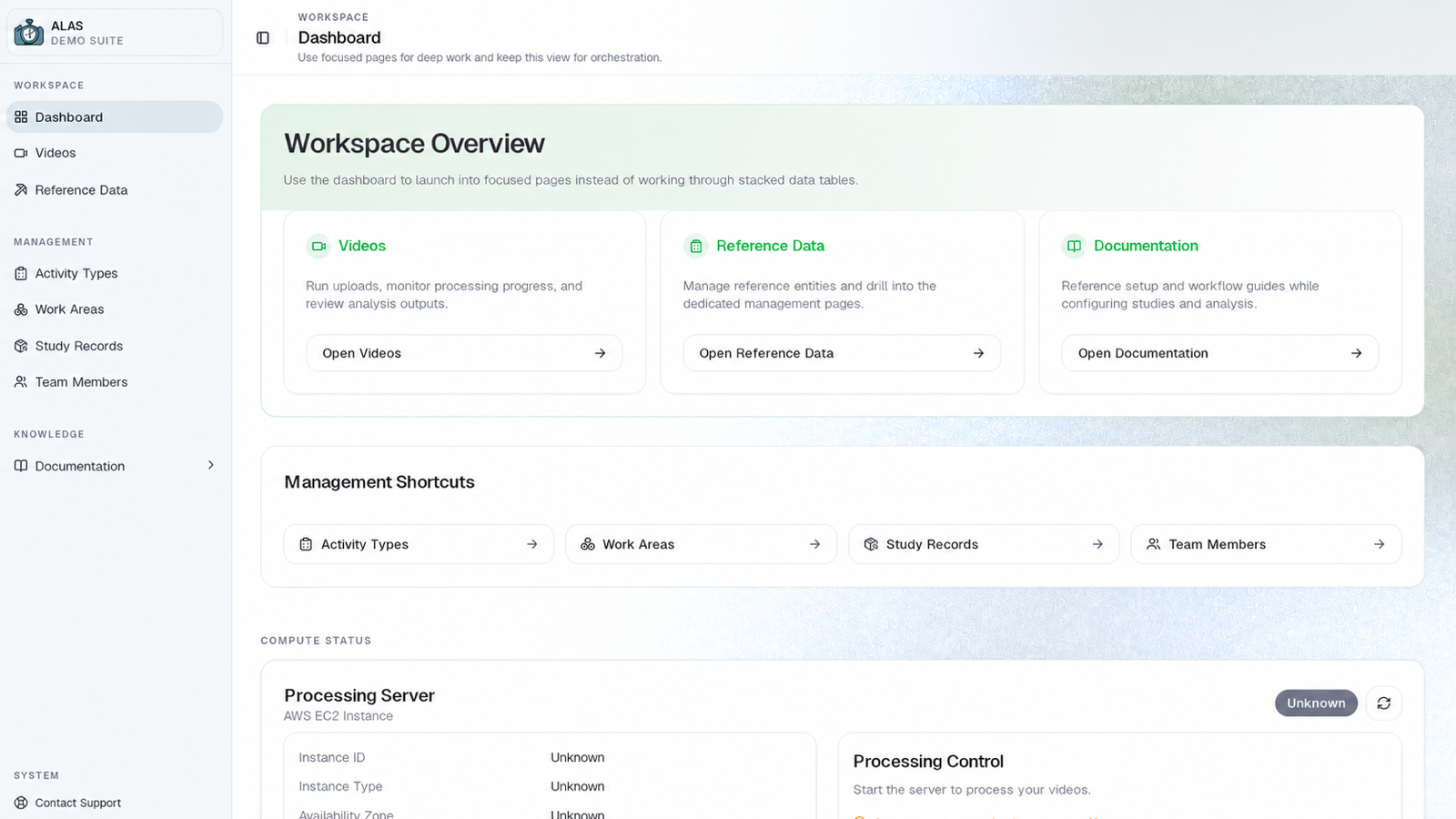
The system combines an authenticated study workspace, resumable video uploads, configurable activity regions, GPU-backed pose estimation, rule-based time attribution, synchronized video review, operational dashboards, and report exports in one workflow.
Explainable Activity Analysis
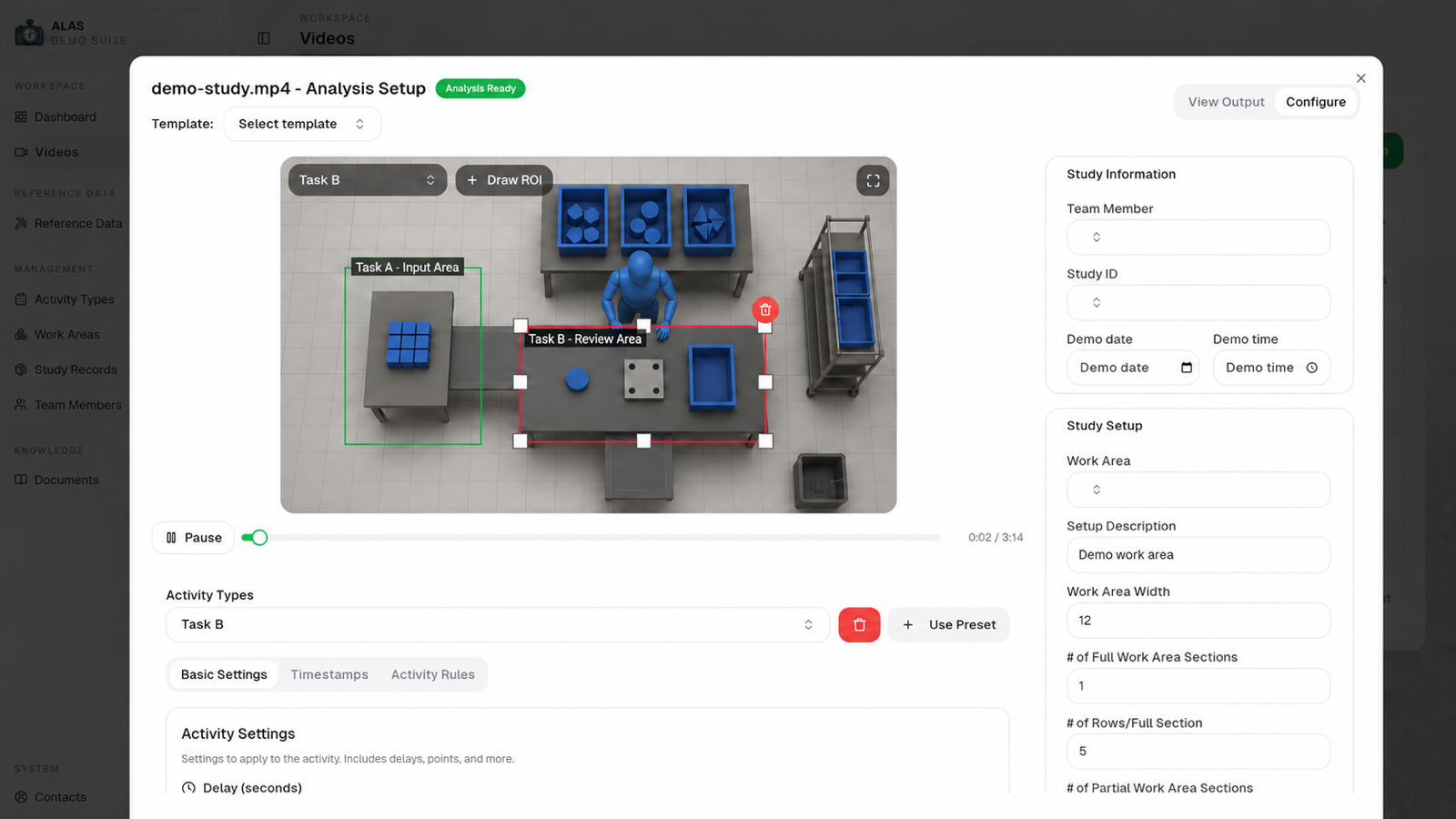
I designed ALAS as two distinct layers. A YOLO Pose and OpenCV pipeline extracts timestamped upper-body points from uploaded footage. An editable analysis layer then maps those points into activities using regions of interest, body-point thresholds, priorities, logical rules, delays, and manual timestamps.
Separating perception from process logic keeps the analysis inspectable. A user can see why time was attributed to an activity and refine the configuration for a different workstation without training a new model. Because ALAS retains the timestamped pose data, many region and rule changes can be recalculated without paying for another GPU inference run.
Processing Architecture
The Next.js application uses Supabase for authentication, PostgreSQL records, and private video storage. Large recordings upload through a resumable Uppy and TUS flow. When a study is queued, the app starts an on-demand AWS EC2 GPU worker that downloads the video, samples and batches frames, runs pose inference, records progress, saves the resulting keypoint data, uploads annotated footage, and cleans up local artifacts.
I added progress and ETA reporting, bounded retries, duration verification, GPU validation tools, structured per-video summaries, and automatic instance shutdown. This made the computer-vision pipeline operable as a product workflow rather than a standalone analysis script, while matching GPU costs to active processing work.
Review and Reporting
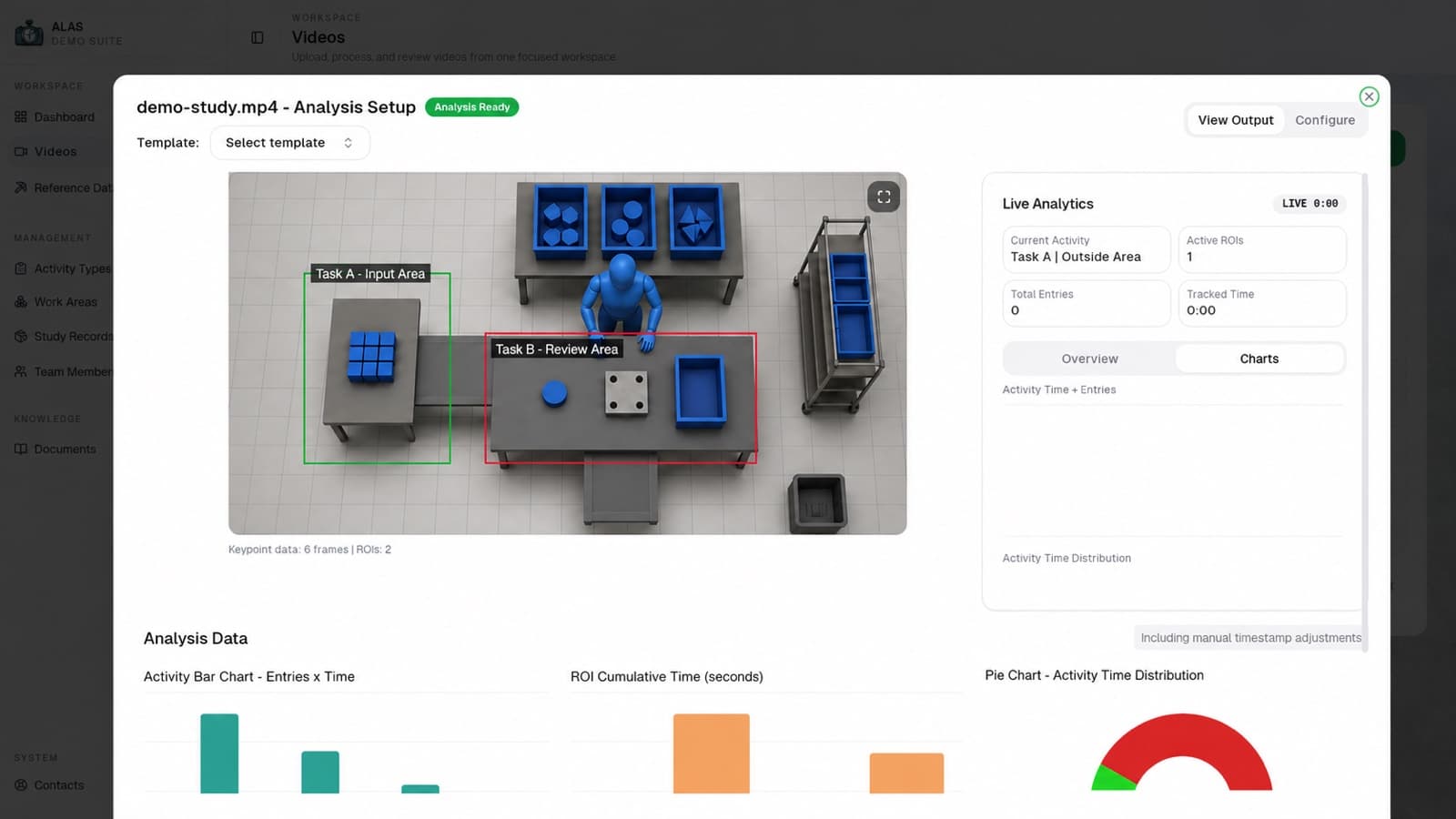
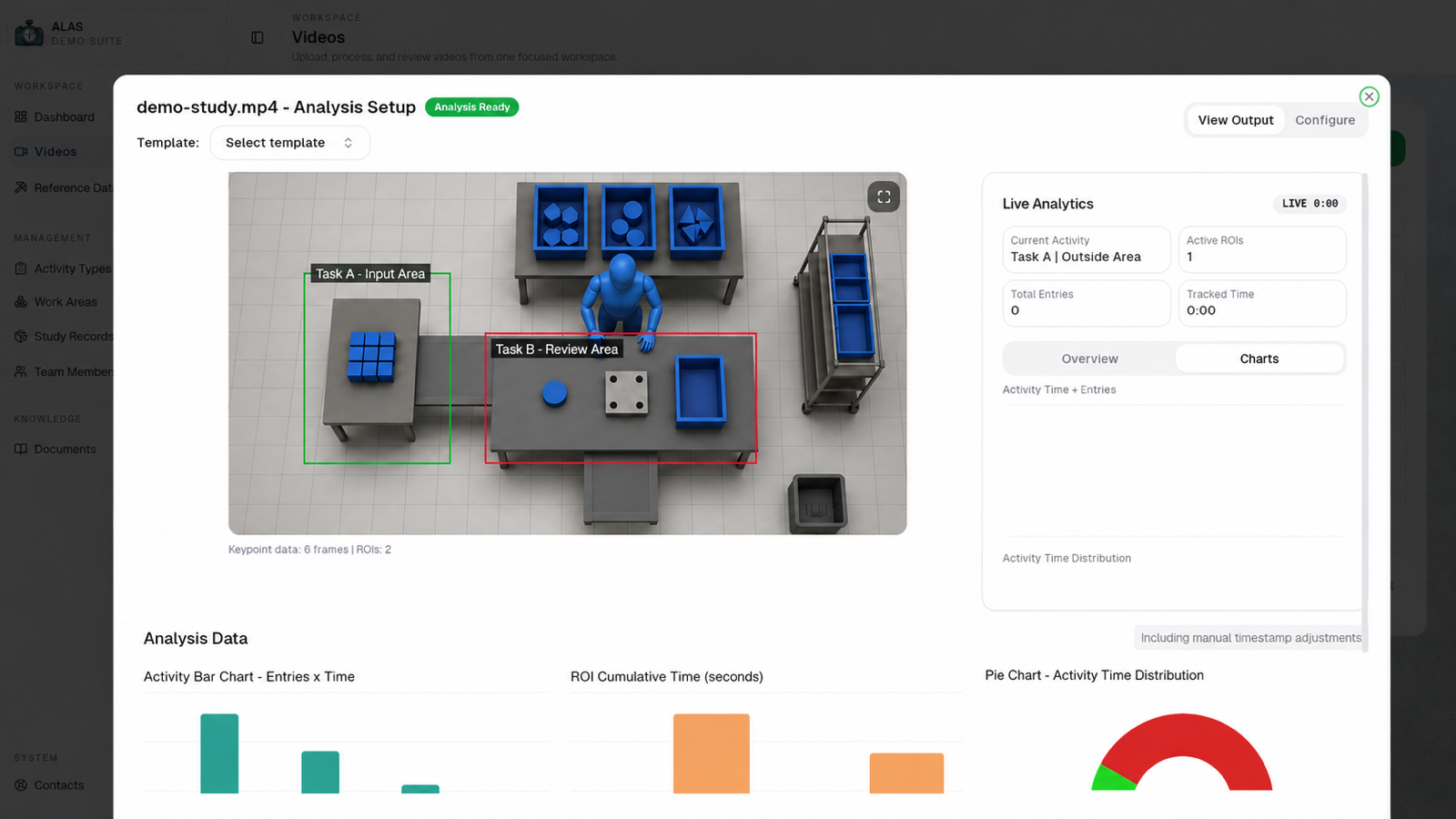
The processed-video workbench synchronizes pose points, active regions, current activity, entry counts, and tracked time with video playback. Users can review activity and ROI tables, time-distribution charts, study-segment statistics, and aggregate study and activity summaries.
Manual timestamps provide precise control for ambiguous work, while reusable templates carry study configuration into future recordings. Analysis results can be exported as CSV data or previewed as a structured Excel report before download.
Highlights
- Built the complete product across frontend, data model, computer vision, processing infrastructure, analytics, and deployment.
- Developed a batched YOLO Pose and OpenCV worker that produces timestamped body-point data and annotated footage.
- Designed interactive video tools for drawing, resizing, rotating, prioritizing, and assigning work regions.
- Built activity rules, manual and section timestamps, reusable templates, and post-processing attribution over stored pose data.
- Added resumable media uploads, processing progress and ETA, bounded retries, duration checks, structured logs, and automated EC2 shutdown.
- Created synchronized analysis review, operational dashboards, charts, event tables, and CSV/Excel export workflows.
Stack
- Next.js 16, React 19, TypeScript, Tailwind CSS, shadcn/ui
- Python, OpenCV, Ultralytics YOLO Pose, PyTorch, CUDA, TensorRT
- Supabase Auth, PostgreSQL, Storage, Row Level Security
- AWS EC2, Uppy/TUS, Recharts, TanStack Table, SheetJS